Beach Buggy Racing 2
Popular Games
Last Played
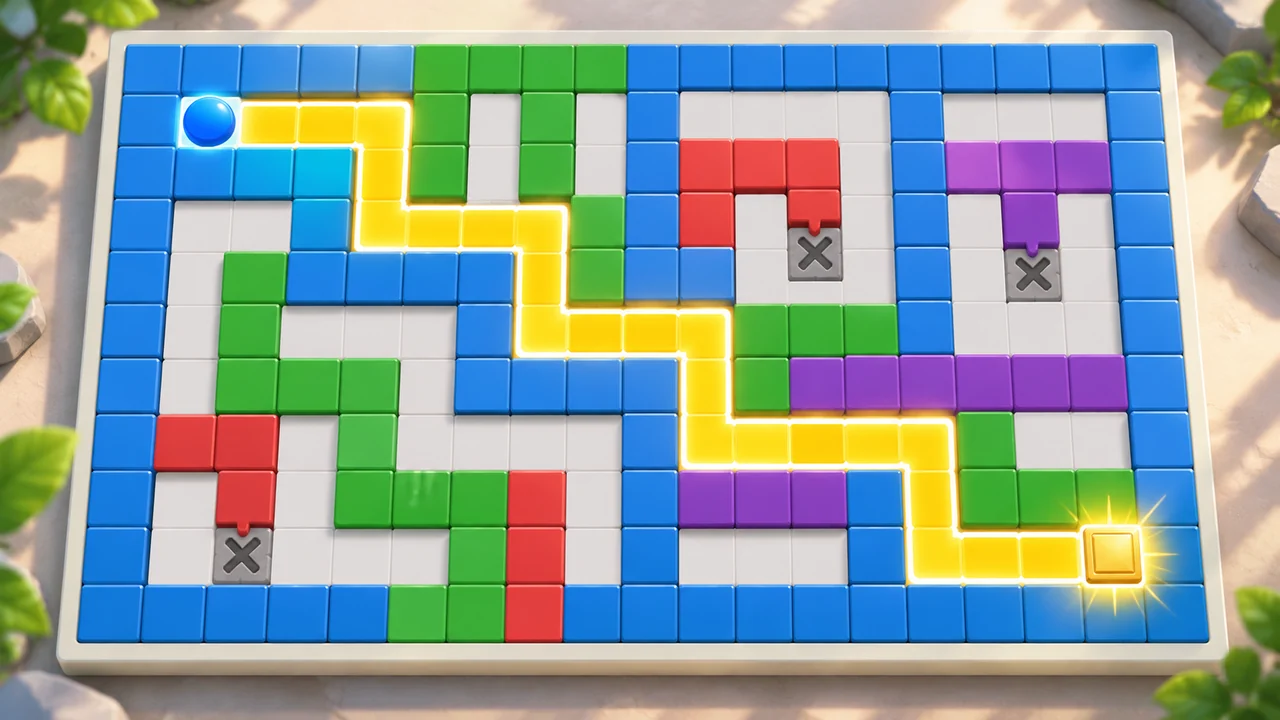
A color maze can look busy before you understand what its colors mean. One board may use colors to mark safe paths, another may ask you to connect matching points, and a third may change the rules as you move. The quickest way to improve is not to rush toward the first visible opening. Pause long enough to identify the goal, read the board and turn the puzzle into a series of smaller decisions.
Before choosing a route, locate the destination and note every instruction shown on screen. Check whether you need to reach one exit, collect something along the way, connect matching colors or avoid crossing a line. Do not assume that familiar colors always mean the same thing. In one puzzle, blue may be a path; in another, it may identify a wall, a target or a move you have not unlocked.
Look for a legend, short tutorial, highlighted square or animation that demonstrates a legal move. If the game lets you undo, treat that as a way to test a hypothesis, not as a reason to move randomly. A single deliberate experiment can reveal a rule; a string of unplanned moves usually leaves you unsure which action mattered.
Scan the maze from the goal backward as well as from the starting point forward. Dead ends near the finish can reveal which corridor must be reached last. Narrow passages, one-way arrows and isolated colored cells can force the route long before you arrive at them. If two regions connect through only one doorway, that doorway is a bottleneck: think carefully about when to enter it and what must already be completed.
Separate the board into regions. Identify the open area around the start, the corridors connecting larger sections and any small pockets that appear easy to miss. This gives you a rough map without needing to memorize every cell. You can then ask a useful question at each junction: which choices preserve a path to the goal, and which choices close off a required area?
When colors correspond to different conditions, name those conditions in plain language. For example, you might think “this route is blocked until the matching switch is active” rather than simply remembering a shade. This is especially helpful when two colors look similar on a small screen. Pay attention to outlines, icons and movement feedback as well as hue, and use the game’s own labels whenever it provides them.
Try to track only the information that affects your next choice. You rarely need to remember the entire board at once. Mark mentally where a color appears, whether it can be crossed, and what changes after an interaction. After a rule changes, scan again; a corridor that was unusable before may now be the most important route.
If you want to practice this style of observation, Color Maze Puzzles offers a focused place to slow down, inspect the colored paths and plan each move before committing. Approach each level as a route-planning problem: the useful clue is often how the available spaces connect, not how quickly you can tap.
A dead end is not always a trap; it may contain a required target that you need to visit and then leave. Before entering, check whether the route allows you to turn around or whether movement is one-way. If a narrow passage serves several parts of the board, avoid blocking it with a path that cannot be retraced. A little forward planning prevents the common mistake of reaching a colored objective while cutting off the only way to finish.
At a junction, compare routes by what they leave available afterward. The shortest-looking corridor may lead into a pocket with no exit, while a longer loop may reconnect you to the central path. In puzzles with multiple goals, consider the order of objectives. Visit a one-way branch at the right time, and leave flexible areas for later choices.
When you are unsure, change one thing at a time. Move to the next junction, observe the result and decide whether the route is still viable. If a move fails, note the reason: perhaps a color condition was misunderstood, a tile could not be revisited, or a corridor was needed for another connection. Resetting can be useful, but only after you have learned something from the attempt.
Take breaks when the board begins to blur together. Returning with fresh attention often makes a hidden connection obvious. On a phone or tablet, make deliberate taps and wait for the game to register them before tapping again. Extra touches can move you past a junction or select a neighboring tile, creating confusion that looks like a puzzle mistake but is really an input mistake.
Some puzzles change their layout or available paths when you activate a tile, complete a connection or collect an object. After any move that changes the board, pause and scan again instead of continuing along the route you planned before the change. A new opening may create a shorter path, while a closed passage may make a previously optional loop essential. Treat the board as a live map that deserves a quick update.
It can help to describe the current state in one sentence: “the lower bridge is open, but the red corridor is still blocked.” This keeps the important conditions in working memory without forcing you to memorize the whole grid. If you lose track, retrace the last confirmed state or restart with a better plan rather than layering guesses onto guesses.
Use the same short routine whenever a maze feels complicated. First, point out the start and goal. Second, read the rule that controls colors or movement. Third, locate bottlenecks and isolated areas. Fourth, trace a possible route in sections rather than one long chain. Finally, test the next move and re-evaluate the board whenever its state changes.
This method leaves room for intuition without depending on guesswork. You can still take a promising route when it appears, but you will know what to check before committing. Over time, you will become faster at recognizing forced paths, useful loops and branches that should be saved for later.
The best solution is not always the route you first imagined. A maze rewards careful observation, flexible planning and a willingness to revise an assumption. By treating each color as a clue and each junction as a choice with consequences, you can turn a crowded board into a clear sequence of manageable steps.